
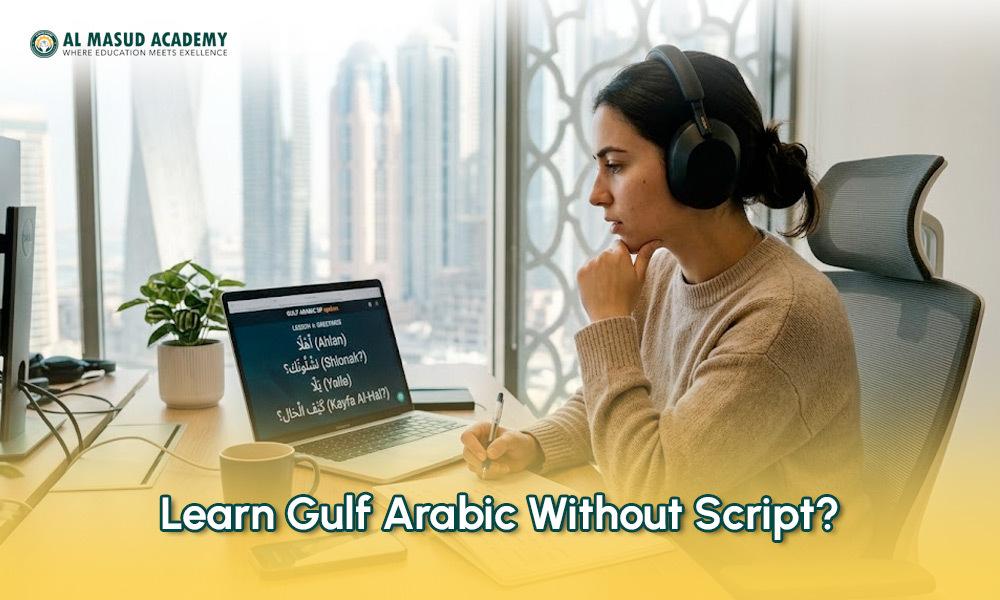
Learn Gulf Arabic Without Script (What Expats Need to Know)
Yes, you can. And if the Arabic script has been the thing stopping you from starting, you can let that go right now.
Gulf Arabic is a spoken dialect first and a written system second, and for most expats living in the UAE, Qatar, or Saudi Arabia, spoken fluency is the skill that actually changes your daily life.
That said, this isn’t a pep talk designed to oversell you on a shortcut. There are real limits to what you can do without the script, and you deserve an honest look at both sides before you decide how to approach this. What follows is exactly that.
Why Spoken Arabic and Written Arabic Are Two Different Skills
Most people treat language learning as a single, all-or-nothing project. You either know Arabic or you don’t. That framing is the reason so many people never start.
Spoken language and written language are genuinely separate skills. Think about how children learn English. A four-year-old can hold a full conversation, tell a story, and negotiate bedtime, but they cannot read a word.
Speaking came first. Reading came years later, through formal instruction.
This isn’t unusual. There are hundreds of millions of adults around the world who speak their native language fluently and have limited or no formal reading ability. Spoken language is natural, human, and primary. Literacy is a skill layered on top.
This separation matters even more for Gulf Arabic specifically.
According to our complete guide to learning local Arabic dialect, the dialect spoken across the UAE, Qatar, Kuwait, Bahrain, Oman, and parts of Saudi Arabia is not formally written in any standardised way.
What gets written in newspapers, government documents, and formal broadcasts is Modern Standard Arabic (MSA), which is a different form entirely.
As we explain in detail why learning only MSA isn’t enough if you live in the Gulf, no one speaks MSA in everyday conversation. When a colleague in Doha cracks a joke or a shopkeeper in Abu Dhabi gives you the price, they’re using Gulf dialect, not the formal written standard.
Even Gulf Arabic speakers themselves often text each other using “Arabizi,” a system that writes Arabic sounds using Latin letters and numbers. The Arabic script is far less central to Gulf dialect communication than most learners assume.
What Transliteration Actually Looks Like in Practice
Transliteration means writing the sounds of one language using the alphabet of another.
For Gulf Arabic learners, that means writing Arabic pronunciation with English letters, so you can start speaking without having to learn a new script at the same time.
Here is what that looks like:
| Gulf Arabic (Transliteration) | English Meaning |
| Kayf ḥālak? | How are you? (to a man) |
| Shukran jazīlan | Thank you very much |
| Wain al-hammam? | Where is the bathroom? |
| Bikam hadhā? | How much is this? |
You can say all four of those right now, without knowing a single Arabic letter. That is the point. Transliteration removes the visual barrier so you can build real spoken skills from day one.
Al Masud Academy’s spoken Arabic courses are built around this approach.
Both the self-paced Guided Flex track and the live Interactive Track use audio-driven, conversation-first lessons in the Gulf dialect. Arabic script appears in supporting materials, but it is never a barrier that blocks you from progressing.
After working with thousands of Gulf-based expats, what we consistently see is that learners who start speaking on day one make faster, more durable progress than those who spend the first months on alphabet drills.
What You Can and Can’t Do Without the Script
This is where most language websites go vague. Here is the honest breakdown.
What you can do without the script:
At work, you can greet colleagues, follow informal conversations, participate in small talk, and respond naturally instead of standing there smiling blankly.
In Gulf culture, the effort to speak Arabic, even imperfectly, lands with real warmth. It signals respect in a way that speaking English never quite does.
In daily life, you can ask prices, negotiate, order food, ask for directions, and handle routine transactions. You can ask “Bikam?” and understand the answer. You can thank people, apologize, and express basic needs without pointing at things and hoping.
In social settings, you can use the correct greetings, respond appropriately, and build the kind of interpersonal warmth that most expats never access because they stay entirely in English.
You can also follow conversations around you.
Understanding what a driver is saying, catching what colleagues are discussing across the room, and knowing when someone is telling a joke at your expense. That passive listening ability alone reduces the isolation that many expats feel.
This covers roughly 90% of what most Gulf-based expats actually need from Arabic in daily life.
What you cannot do without the script:
You won’t be able to read road signs, local restaurant menus, government forms, or Arabic-only websites.
In practical terms, most signs in the Gulf are bilingual, and most official expat interactions happen in English, but you will encounter situations where written Arabic matters.
WhatsApp messages in Arabic script will stay unreadable. Formal or older-generation messages often come in script rather than Arabic.
If your goals later expand to religious study, classical Arabic literature, or Arabic journalism, the script becomes essential. Script-free spoken fluency is a foundation for daily life, not a path into those areas.
Good to Know: Many expats live and work in the Gulf for years, build strong relationships in spoken Arabic, and never formally learn the script.
English remains a major working language across the GCC, which means written Arabic is rarely a professional necessity for most expat roles.
The Profiles of Learners Who Do This Successfully
The most common student at Al Masud Academy is someone who has been in the Gulf for months or years, has been getting by entirely in English, and has hit the point where they want to actually connect, not just manage.
One pattern we see consistently: professionals who enroll with zero Arabic, complete the three-month live Interactive Track, and report that interactions with Emirati or Qatari colleagues shift noticeably.
The change isn’t always about what gets said. It’s about how people respond when they see the effort.
Another common profile is the trailing spouse navigating daily life, markets, schools, and local services without a professional interpreter.
Many of these learners go from zero Arabic to handling daily transactions and basic social interactions within two to three months of consistent practice.
A third profile is the mid-career professional who has been in the Gulf for three or more years and feels embarrassed that they still don’t speak any Arabic.
These learners often report the fastest emotional payoff because they’re already motivated, already immersed in the sound of the dialect, and just need a spoken-first entry point to unlock what they’ve been absorbing passively.
None of these outcomes required learning the script first. All of them were built on spoken Gulf dialect with transliteration-supported learning.
Pro Tip: If you’re curious how quickly you can reach conversational ability, the timeline breakdown in how long it takes to speak Gulf Arabic is worth reading before you choose a course format.
When to Learn the Script (and When to Leave It)
Learn the script when you actually need it, not because someone told you it’s the proper way to start. Here are the signs you’re genuinely ready:
- You’re already holding conversations comfortably in basic spoken Gulf Arabic
- You keep running into written Arabic and want to read it yourself
- You’re thinking about expanding toward MSA or classical Arabic
- You feel curious about Arabic letters rather than intimidated by them
If none of those are true yet, the script can wait without consequence.
When the time does come, the encouraging reality is that the Arabic alphabet has 28 letters, and most structured approaches get you to letter-recognition level within two to four weeks of focused daily practice.
Once you already speak Gulf Arabic, the script becomes a way of labeling sounds you already know, which makes it substantially easier to learn than if you tried to tackle both simultaneously from zero.
Think of how many English words you could say before you learned to read. That prior knowledge made reading dramatically faster. The same principle applies here.
How to Start Speaking Gulf Arabic Today
Al Masud Academy offers three course formats built specifically for expats approaching this from the spoken dialect first:
Master the Gulf Dialect (229 AED) — 47 pre-recorded sessions, weekly live Zoom support, quizzes, a course book, lifetime access, and a Gulf dialect certificate. Best for learners who need flexibility around a work schedule.
Spoken Arabic Level 1: Live batch (369 AED) — A three-month live group program with 24 live sessions, real-time feedback, recordings for missed classes, and peer learning. Best for learners who want structure and accountability.
Every format starts with spoken Gulf dialect and prioritises real conversation from the first session.
The Arabic script appears in supporting materials, never as a prerequisite. You can explore all options on the courses page.
Al Masud Academy also offers a free trial class via Zoom before you commit to anything.
You can experience the spoken-first method, meet the instructor, and see whether this approach fits how you learn, all before spending a single dirham.
The Arabic script will still be there when you’re ready for it.
Your colleagues, your neighbours, the shopkeeper, the driver who knows every shortcut in the city, they’re already here, already speaking, and already open to connecting with you.
The only thing standing between you and that is getting started.
Frequently Asked Questions
Do I need to know the Arabic alphabet before joining your course?
No. All courses start from zero and use English transliteration, so you can speak from day one.
Will I be able to read Arabic menus and signs after the Level 1 course?
Not independently. Level 1 focuses on the spoken Gulf dialect, and reading Arabic script is a separate skill covered later.
Is learning Gulf Arabic without the script considered ‘real’ Arabic?
Yes. Spoken Gulf dialect is the living, everyday language of the UAE, Qatar, and the wider GCC, and fluency in it is completely legitimate.
What if I want to learn the script later, can I add it on?
Absolutely. The script is always available as a next step, and speaking first actually makes learning it easier down the line.
Are there any advantages to learning the script alongside speaking?
For most expats, no. Splitting focus early slows progress, and the script adds the most value once you already have spoken confidence.
You May Also Like
You don’t need a language degree, a sabbatical, or two free hours a day. If you live and work in...
-
-
April 3, 2026
Most expats working in the Gulf will spend years nodding politely through Arabic greetings, responding with a vague smile, and...
-
-
April 1, 2026

You keep hearing people mention “Gulf Arabic,” “Khaleeji,” and “Emirati Arabic.” Are they talking about the same thing? Not quite....
-
-
February 27, 2026