
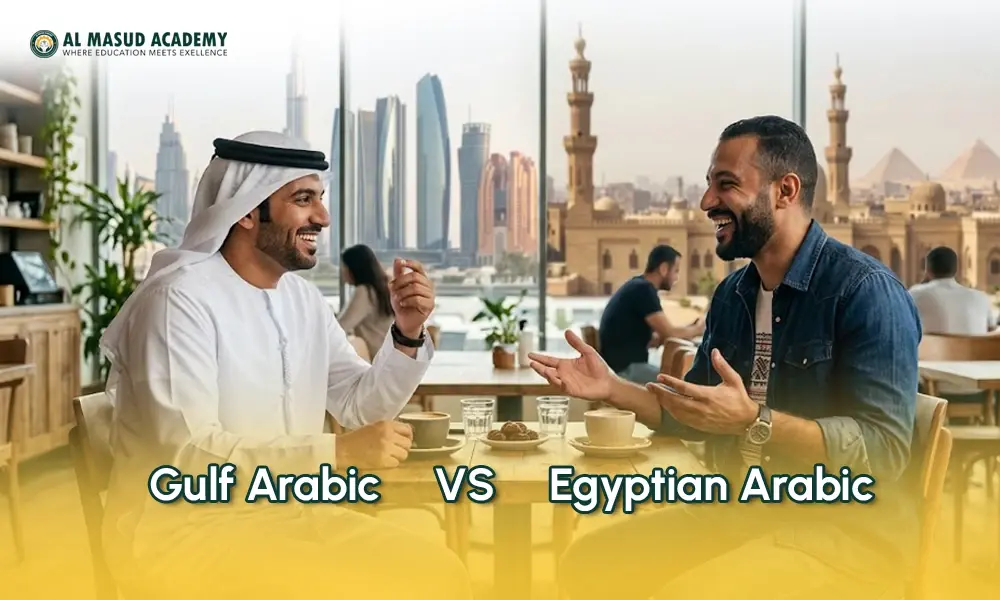
Gulf Arabic vs Egyptian Arabic: Which Should You Learn?
Both Gulf Arabic and Egyptian Arabic are powerful dialects, but they serve very different purposes. Gulf Arabic (also called Khaleeji or Khaliji) is the dialect spoken in the UAE, Qatar, Saudi Arabia, Kuwait, Oman, and Bahrain. It is the right choice if you live in, work in, or plan to move to the GCC region. Egyptian Arabic is the most widely understood Arabic dialect thanks to Egypt’s massive film and TV industry. It is great for media lovers and travelers visiting Egypt. For expats in the Gulf, Gulf Arabic is clearly the choice. For entertainment and broad coverage of the Arab world, Egyptian Arabic has an edge.
If you are thinking about learning Arabic, you have probably already hit the Gulf Arabic vs Egyptian Arabic, which one should you pick?
Both are spoken by tens of millions of people. Both have real career and social value. But they sound different, feel different, and open doors to very different parts of the world.
The playbook will walk you through everything you need to know to make a smart decision. No jargon, no confusion. Just clear answers.
What Makes These Two Dialects So Different?
Gulf Arabic and Egyptian Arabic are two distinct spoken dialects of Arabic that developed in different parts of the world, with distinct cultural influences, sounds, and vocabularies.
While they share the same roots and the same written script, hearing one does not automatically mean you understand the other.
Arabic itself is not a single language, as most people imagine. Modern Standard Arabic (MSA) is the formal written version used in newspapers and official documents.
But nobody wakes up in the morning and says ‘Good morning’ in MSA to their family. People use their local spoken dialect instead.
That is where Khaleeji Arabic vs Masri Arabic comes in. Khaleeji means Gulf. Masri means Egyptian.
They are two of the most important spoken dialects in the Arab world.
Vocabulary: Where Gulf and Egyptian Arabic Diverge Most
Vocabulary is where you will feel the gap most clearly. The two dialects use completely different everyday words for many common things.
Here is a quick look at some of the most common differences:
| English Meaning | Gulf Arabic (Khaleeji) | Egyptian Arabic (Masri) |
| How are you? | Shloonak / Kee Haalik | Izzayak |
| What? | Shnu / Esh | Eeh |
| Now | Heen / Taw | Dilwaqti |
| Come | Ta’aal (similar) | Ta’aal |
| Good / Fine | Zain / Tamam | Tamam / Kuwayis |
| Car | Sayara | Arabiyya |
| Money | Floos | Floos / Masari |
| A lot | Waajid / Wayed | Kteer / Khalis |
As you can see, some words overlap, but many are completely different. If you walk into a shop in Dubai using Egyptian Arabic, locals will understand you, but your words will feel foreign to them.
Pronunciation Differences You’ll Actually Notice
One of the biggest differences between the two dialects is the letter “j” (jeem). In Gulf Arabic, it is pronounced as a soft ‘y’ sound in some Gulf countries, or a hard ‘j’ in others.
In Egyptian Arabic, the same letter is pronounced as a hard ‘g’ sound. So the Arabic word for ‘beautiful, ‘jameel, becomes ‘gameel’ in Egyptian Arabic.
A few more pronunciation differences worth knowing:
- Gulf Arabic tends to be slower and clearer, with each letter pronounced carefully. Many learners find this easier to follow.
- Egyptian Arabic is faster, more rhythmic, and has a distinct nasal quality that makes it instantly recognizable.
- The letter ‘q’ (qaf) is often dropped or replaced in Egyptian Arabic, but is kept in Gulf Arabic.
- Gulf Arabic has Persian and Urdu loanwords because of historical trade routes. Egyptian Arabic is influenced by French, Greek, and Coptic.
Grammar Patterns That Separate the Two
At a basic level, the grammar structure is similar. Both dialects use the same verb roots and follow the same general Arabic sentence order.
- But there are differences in how questions are formed, how gender is handled in daily speech, and in the tone’s formality or informality.
- Gulf Arabic often drops vowels from the middle of words, making speech sound more compact.
- Egyptian Arabic is known for being more expressive and emotionally colorful in its phrasing.
- Negation in Gulf Arabic often uses ‘ma’ before the verb. In Egyptian Arabic, ‘mish’ or ‘mesh’ is very common.
- Gulf Arabic uses ‘ch’ sounds in some dialects (especially Kuwaiti) that Egyptian Arabic does not have at all.
Who Speaks Each Dialect and Where
Understanding where each dialect is spoken helps you make the right choice for your goals.
Where Gulf Arabic Is Used (Countries and Communities)
Gulf Arabic is the native dialect of the Arabian Peninsula. It is the primary spoken Arabic in:
- United Arab Emirates (UAE), including Dubai and Abu Dhabi
- Qatar including Doha
- Saudi Arabia (Najdi and Hejazi dialects are regional, but Gulf Arabic covers the eastern regions and is widely understood)
- Kuwait
- Bahrain
- Oman (with its own regional flavor)
If you are an expat already living in one of these countries, or if you are planning to relocate there for work, Gulf Arabic for expats is the most practical choice.
The Gulf region is home to millions of expats, especially from South Asia, Southeast Asia, and Africa.
Learning the local dialect shows respect and opens up real human connections at work, in shops, and in daily life.
If you are a working professional in the GCC, it is mandatory to learn Gulf Arabic to see exactly how it benefits your career.
Where Egyptian Arabic Dominates (Media, Film, and Diaspora)
Egyptian Arabic is the dialect of Egypt, with a population of around 105 million. That alone makes it the most widely spoken Arabic dialect among native speakers. But what really gives it global reach is Egypt’s entertainment industry.
From the 1940s to the 1980s, Egypt was the Hollywood of the Arab world. Egyptian films, music, and TV shows were exported across the Arab world for decades.
It means that Egyptian Arabic for watching shows and understanding Arab pop culture is a real advantage.
Even today, many Arabic TV dramas and popular movies are made in Egyptian Arabic or use it as the default.
- Egypt has the largest population in the Arab world, with over 105 million people.
- Egyptian TV shows and films have been broadcast across 22+ Arab countries for decades.
- Large Egyptian diaspora communities exist in the Gulf, Europe, and North America.
- Many Arab language learners start with Egyptian Arabic because of the availability of learning resources.
Can Gulf and Egyptian Speakers Understand Each Other?
Yes, to a degree, but with effort. This is one of the most common questions in any comparison of spoken Arabic dialects, and the honest answer is: partial understanding, not full fluency.
Because Egyptian Arabic has been broadcast across the Arab world for so long, most Gulf Arabs have some exposure to it and can follow it reasonably well.
But the reverse is not always true. An Egyptian who has never heard Gulf Arabic may struggle with the accent, the vocabulary, and the phrasing.
In practice, when a Gulf Arabic speaker and an Egyptian Arabic speaker meet, they often shift to a more neutral, MSA-influenced style to bridge the gap.
So can Gulf and Egyptian speakers understand each other? Yes, but it takes adjustment from both sides.
Side-by-Side Comparison: Gulf Arabic vs Egyptian Arabic
Here is a clear, simple table to compare both dialects across the factors that matter most to a learner:
| Factor | Gulf Arabic (Khaleeji) | Egyptian Arabic (Masri) |
| Countries spoken in | UAE, Qatar, Kuwait, Saudi Arabia, Oman, Bahrain | Egypt (105M+ speakers) |
| Total speakers | Around 35 to 50 million native speakers | Over 100 million native speakers |
| Most useful for | Living/working in GCC, business in the Gulf | Arabic media, travel, and a wide Arab world familiarity |
| Media presence | Limited outside GCC | Very high across the entire Arab world |
| Pronunciation speed | Slower and clearer | Faster, more rhythmic |
| English speakers’ ease | Moderate (clearer pronunciation helps) | Moderate (more resources available) |
| Similarity to MSA | Closer to MSA in some grammar areas | Somewhat further from MSA in pronunciation |
| Job market value | Very high for GCC employment | High for Egypt, limited elsewhere |
| Learning resources | Growing, especially online | More abundant overall |
| Cultural exposure | Strong in Gulf countries | Strong globally through film and music |
Which Dialect Is More Useful for Your Goals?
This question has a clear answer once you know what you actually want from Arabic. Let us break it down by situation.
If You’re Moving to or Working in the Gulf
The answer is simple. Learn Gulf Arabic. If you live or work in Dubai, Abu Dhabi, Doha, Riyadh, or any other GCC city, Gulf Arabic is what you will hear every single day.
Your Emirati or Qatari colleagues, your neighbors, and your local shop owners all speak Gulf Arabic at home and in casual settings.
Learning Egyptian Arabic in this context is like moving to London and learning Australian slang. It helps a little, but it is not quite right.
Arabic dialect for business in the Gulf means Gulf Arabic, full stop. Even a basic level of Gulf Arabic makes a real difference in how locals receive you at work and in social situations.
If You Love Arabic TV Shows and Music
If your main goal is to enjoy Arabic entertainment, then Egyptian Arabic gives you the widest access.
Most classic Arabic films, many popular TV shows, and a large portion of mainstream Arab pop music use Egyptian Arabic or are understandable through it.
However, Gulf-produced content is growing fast. Gulf Arabic music, especially Khaleeji pop, is hugely popular across the region. If you want to enjoy the cultural output of the GCC specifically, Gulf Arabic helps there too.
If You Want to Be Understood Across the Arab World
If your goal is the most widely understood Arabic dialect, Egyptian Arabic has a historical edge. Because of decades of Egyptian film and television, most Arabic speakers across different countries have been exposed to it. It makes Egyptian Arabic a kind of informal common ground.
That said, Modern Standard Arabic (MSA) is technically the most universally understood formal variety. But MSA is written, not spoken.
Historically, Egyptian Arabic has had the broadest reach in everyday conversation. Gulf Arabic is understood within the Gulf and by anyone who has worked or lived there.
When comparing Levantine, Gulf, and Egyptian Arabic, Egyptian Arabic has historically won in cross-dialect recognition, but Gulf Arabic is catching up as Gulf media and business influence grow globally.
Which One Is Easier for English Speakers to Learn?
It is roughly equal, but Gulf Arabic may feel slightly more accessible for beginners.
Here is why many learners find Gulf Arabic vs Egyptian Arabic tilted toward Gulf Arabic at the start:
- Clearer pronunciation. Gulf Arabic tends to pronounce each letter more distinctly, which helps new learners catch individual sounds.
- Slower pace. Gulf Arabic is generally spoken at a steadier pace compared to the faster flow of Egyptian Arabic.
- Less Coptic and Greek influence. Egyptian Arabic has absorbed sounds from ancient Coptic and Greek that do not appear in other languages, which can feel unfamiliar.
- More resources for Egyptian Arabic. Egyptian Arabic has more textbooks and free online materials, which evens out the learning curve.
Overall, both dialects are learnable at a beginner level with structured lessons. The bigger factor is your goal, not the difficulty.
If you are asking whether Egyptian Arabic is easier than Gulf Arabic, the difference is small. What matters more is whether the dialect you choose is relevant to your actual life.
For context, is Gulf Arabic harder to learn than Egyptian Arabic?
Not significantly. Both will take consistent study and practice over 3 to 6 months before basic conversation becomes comfortable.
The Case for Learning Gulf Arabic First
There is a strong practical argument for Gulf Arabic, especially if you have any connection to the GCC region:
- The Gulf countries have some of the highest average salaries in the world. Arabic language skills give you a direct advantage in landing and keeping jobs there.
- Gulf Arabic is spoken across six countries with combined populations of around 60 million, plus tens of millions of expats who interact with local Arabic daily.
- The Gulf dialect is closer to Modern Standard Arabic in some grammatical areas, so it can serve as a stepping stone to reading and formal writing, too.
- Gulf Arabic learning communities are growing fast online, with more courses, YouTube channels, and conversation partners available than even five years ago.
- Gulf Arabic for expats is not just a nice-to-have. In many workplace contexts across the UAE, Qatar, and Saudi Arabia, it is becoming a real differentiator.
If you are a Bangladeshi professional considering working in the Gulf, the dialect that best serves your ambitions is the one you choose.
It is also the only dialect that will feel natural when you arrive at your GCC workplace, not a transplanted version from a different country’s media culture.
For those who want to explore the best Arabic dialect for travel to the UAE or Saudi Arabia, Gulf Arabic is the only answer that makes complete sense. You will use it from day one, at the airport, in the taxi, at the office, and with your neighbors.
For anyone asking about which Arabic dialect is most useful in a Gulf professional context, the case for starting with Gulf Arabic is clear and direct.
Conclusion
The Gulf Arabic vs Egyptian Arabic debate is really just a question about your goals. Both are rich, real, living dialects. Both will take you places. But they take you to different places.
If you are living in or heading to the Gulf, learn Gulf Arabic. It will open doors at work, build relationships with locals, and enrich your life in the region. If you love Arabic drama, music, and film, Egyptian Arabic will unlock a huge world of content.
For most Bangladeshi learners interested in the Gulf job market, the choice is Gulf Arabic. It is practical, in demand, and the dialect locals actually speak at home and in casual settings across the UAE, Qatar, Saudi Arabia, and the wider GCC.
Ready to start? Learn Gulf Arabic and begin speaking real Gulf Arabic in weeks, not years.
Frequently Asked Questions on Gulf Arabic vs Egyptian Arabic
Is Gulf Arabic harder to learn than Egyptian Arabic?
Not really. Both dialects take around the same time and effort to reach a conversational level. Gulf Arabic has clearer pronunciation and a slightly slower pace, which some beginners find helpful. Egyptian Arabic has more free online learning resources. The difficulty is roughly equal. Your motivation and consistency matter far more than which dialect you choose.
Can an Egyptian Arabic speaker understand Gulf Arabic?
Partially. An Egyptian speaker who has been exposed to Gulf media or has worked in the Gulf can follow Gulf Arabic reasonably well. But without that exposure, Gulf Arabic can be difficult because the vocabulary, accent, and some grammar patterns are quite different. Gulf Arabic speakers generally find Egyptian Arabic easier to understand because of Egypt’s massive media presence across the Arab world.
Which Arabic dialect is spoken by the most people?
Egyptian Arabic has the most native speakers of any single Arabic dialect, with over 100 million speakers in Egypt alone. When you add the Egyptian diaspora in the Gulf, Europe, and elsewhere, that number grows even further. Gulf Arabic has around 35-50 million native speakers across the six GCC countries.
Is Egyptian Arabic the closest to Modern Standard Arabic?
Not exactly. Some scholars consider Gulf Arabic to be closer to Modern Standard Arabic in certain grammatical areas. However, Egyptian Arabic has strong Coptic and Greek influences, making its pronunciation quite distinct from MSA. In terms of grammar and sentence structure, Gulf Arabic is often considered closer to formal written Arabic.
What Arabic dialect should I learn for Dubai or Saudi Arabia?
Gulf Arabic, without question. If you are moving to Dubai, Abu Dhabi, Riyadh, Jeddah, Doha, or any other Gulf city, Gulf Arabic is the language locals use in daily life. Egyptian Arabic will help you communicate with Egyptian expats in the region, but it will not help you connect with Emirati, Saudi, or Qatari locals in the same natural way.
Is Khaleeji Arabic a single dialect or multiple dialects?
Khaleeji Arabic is an umbrella term for a group of related dialects spoken across the GCC. There are regional differences between Emirati Arabic, Qatari Arabic, Kuwaiti Arabic, and Saudi Gulf Arabic. But they are mutually intelligible in most situations. If you learn Khaleeji Arabic as taught in a structured course, you will be understood across all six Gulf countries.
Which Arabic dialect appears most in TV shows and movies?
Egyptian Arabic has historically dominated Arabic-language film and television. Egypt has been the Arab world’s entertainment capital for decades, and most classic Arabic films and popular TV dramas use Egyptian Arabic. However, Gulf-produced content, especially Khaleeji music and reality TV, is growing fast and bringing Gulf Arabic to wider audiences.
You May Also Like
You don’t need a language degree, a sabbatical, or two free hours a day. If you live and work in...
-
-
April 3, 2026
Yes, you can. And if the Arabic script has been the thing stopping you from starting, you can let that...
-
-
April 2, 2026
Most expats working in the Gulf will spend years nodding politely through Arabic greetings, responding with a vague smile, and...
-
-
April 1, 2026