

Gulf Arabic for Working Professionals in UAE: 3-Month Plan
You don’t need a language degree, a sabbatical, or two free hours a day.
If you live and work in the UAE, you’re already surrounded by Gulf Arabic every single day. The question isn’t whether you have time to learn Gulf Arabic as a working professional in the UAE, it’s whether you have the right plan. And that’s exactly what this guide gives you.
Before you even ask how long it takes to speak Gulf Arabic, know this: most expats reach basic conversational confidence in three months.
Not fluency. Not perfection. Real, useful confidence that changes how people treat you at work and in daily life.
Why Gulf Arabic Is Different from What Standard Arabic Courses Teach
Most beginner Arabic courses, including popular apps and university programs, teach Modern Standard Arabic (MSA).
MSA is the formal written form used in newspapers, official speeches, and legal documents. According to the Arabic Language Hub, it differs from the spoken dialects across the region in pronunciation, vocabulary, and everyday expressions.
The problem? Nobody actually speaks MSA in daily life.
As Al Masud Academy puts it, trying to use MSA at a Dubai petrol station is like trying to order a pizza in 16th-century Shakespearean English. People may understand you, but the disconnect is immediate.
Gulf Arabic (also called Khaleeji) is what you hear everywhere in the UAE.
It drops many of the complex grammar rules that make written Arabic intimidating. Here are phrases any UAE professional hears every single day:
- Khalas — Done / Finished (used constantly in meetings)
- Yalla — Let’s go / Hurry up (said before every late meeting)
- Inshallah — God willing (the Gulf’s answer to every deadline)
- Mafi mushkila — No problem (heard in every service interaction)
- Shukran — Thank you (the one word that opens every door)
None of these requires you to learn the alphabet first. They’re the real operating language of daily professional life, and they’re what a course built around the Gulf dialect actually teaches.
The Real Reason Most UAE Expats Never Start
Most expats say, “I’ll learn Arabic one day” for three to five years and never do.
The blockers aren’t a lack of interest. The most common barriers are time pressure, decision paralysis over which dialect or format to choose, and a quiet fear of looking foolish in front of colleagues or locals.
Recognising those blockers is already half the battle. The other half is making the first step small enough that you can’t say no to it.
If you’ve tried apps and felt frustrated, that’s not a character flaw.
Apps built for MSA teach you a language you’ll rarely hear in the UAE. Gulf Arabic and MSA differ in grammar, pronunciation, and vocabulary, which is why content built around Khaleeji Arabic for beginners produces faster results for UAE-based learners than any general-purpose tool.
How Much Time Do You Actually Need Each Day
Yes, you can make real progress with 20 to 30 minutes a day, four to five days a week.
That’s the honest answer. You don’t need to block out evenings or rearrange your life.
According to ArabicPod101, the FSI estimates reaching functional conversational ability in Arabic with one to two hours of daily study over roughly a year.
But for a busy professional in the UAE, the goal isn’t fluency, it’s functional confidence in your daily environment. That milestone is achievable in three months with far less daily time.
Here’s what a realistic daily Arabic schedule actually looks like:
- Morning commute (15 minutes each way): Audio phrases and listening
- Lunch break (10 minutes): Flashcard or vocabulary review
- Three evenings per week (25 to 30 minutes): Structured lesson or live class
The advantage most people overlook is that you’re already passively immersed. Your colleagues, drivers, security guards, and shopkeepers are free to attend daily practice sessions. You’re not starting from zero. You’re starting from passive exposure, and you just need the vocabulary to activate what you already hear.
Your 3-Month Gulf Arabic Plan Built Around a Full-Time Schedule
This plan is concrete and built around a full Gulf work schedule. Forget vague goals. Here’s exactly what to focus on each month.
Month 1 — Build the Foundation Without Overcomplicating It
The goal in Month 1 is to survive and initiate any basic interaction with confidence.
Focus on core greetings, numbers one to one hundred, and ten essential workplace phrases. Introduce yourself in simple Arabic. That’s it.
What not to do: don’t start with grammar rules or the Arabic alphabet.
Both are useful eventually, but neither is necessary to start speaking. As Al Masud Academy’s Gulf dialect course explains, spending your first month on the Arabic script is one of the most common reasons beginners quit.
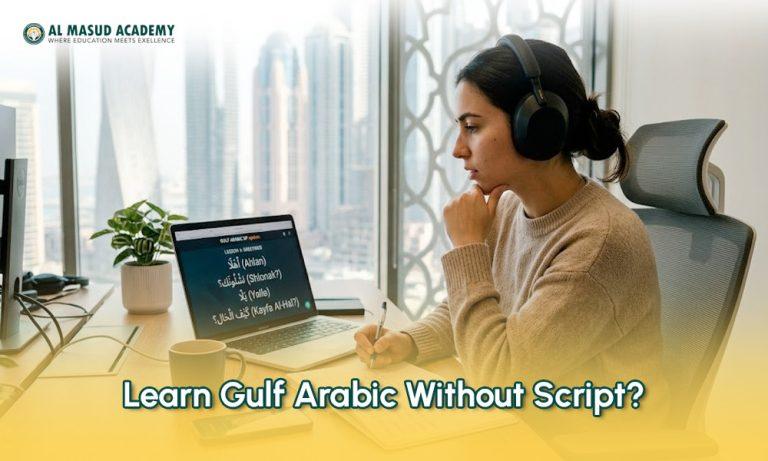
Use transliteration, English phonetics alongside Arabic, so you can start speaking immediately.
Daily routine: Listen to Gulf Arabic audio on your commute. Review five new words at lunch with a spaced-repetition app like Anki. Do two 25-minute self-study sessions in the evenings.
Month 2 — Navigate Workplace Arabic and Real Conversations
The goal in Month 2 is to hold short professional interactions and basic small talk.
Learn meeting phrases: Muta’akhir (late), Intiha (finished), Mumkin (can you / is it possible?). Practice asking for clarification. Learn how to talk about the weather, weekend plans, food, and where you’re from.
How to practice at work without feeling awkward: start small. Greet the security guard in Arabic.
Say Shukran to the cafeteria staff. Ask a colleague, “Keif halak?” and let them respond, even if you only catch half of it. These micro-interactions compound fast.
This is also the ideal time to join a live group class if your schedule allows. Live conversation with feedback accelerates progress more than any app alone.
Increase your evening sessions to three per week.
Month 3 — Build the Confidence to Handle the Unexpected
The goal in Month 3 is to handle unscripted interactions without freezing.
Learn directions, shopping vocabulary, how to negotiate prices, and the phrase that removes all pressure: “Ana lessa beta’allam”, I’m still learning.
Use your environment as the classroom.
Take a taxi and hold the full conversation in Arabic. Order at a restaurant without pointing. These aren’t language exercises; they’re confidence builders that no app can replicate.
Signs you’re genuinely progressing: you catch words in background conversations at work, locals smile wider when you try (this is universal), and you no longer mentally translate before speaking simple phrases.
Check the full breakdown of what to expect in our guide on the realistic Gulf Arabic learning timeline.
How to Fit Arabic Practice Into a Full UAE Work Schedule
The UAE working week is often six days, with long commutes and evening social obligations, leaving less margin than most.
The solution is to embed Arabic learning for a busy schedule inside time you already spend, not add it on top.
The commute method: Audio-based learning is perfectly suited to the UAE commute, whether you’re driving on Sheikh Zayed Road or riding the Dubai Metro.
Passive-to-active transfer, hearing patterns until they feel familiar, is one of the most effective methods for Arabic for expats in the UAE.
Gulf Arabic YouTube channels, dialect-specific podcast episodes, and audio apps all work well here.
The lunch review: Keep a vocabulary list of five words you want to own that week.
Review them with a spaced-repetition app at lunch. Ten minutes, three to five days a week, compounds significantly over a month.
The evening session: This is where structured learning happens, a live online class, a recorded course you can pause and rewatch, or structured self-study with a Gulf Arabic curriculum.
The evening session is the one to protect. Skipping it for more than two days in a row breaks the momentum most beginners need to push through the first month.
For a detailed comparison of which format suits your schedule best, see Live Zoom vs Self-Paced: Best Way to Learn Gulf Arabic Online.
Choosing the Right Learning Format for Your Lifestyle
There’s no single best format. There’s a best fit for your personality and schedule.
| Format | Best For | Limitation |
| Recorded self-paced courses | Busy, unpredictable schedules; introverts | No live feedback; easy to procrastinate |
| Live group classes | Accountability-driven learners; speaking practice | Fixed schedule required; slightly higher commitment |
If you’ve started and stopped with apps before, the missing ingredient is almost always live interaction.
Hearing your own pronunciation corrected and experiencing real Gulf Arabic conversation at a manageable peace is what makes the difference.
A structured online Arabic class for UAE working hours that combines recorded content with live sessions is the format most working expats find sustainable. Start with the 100 most common Gulf Arabic words and phrases to hit the ground running before your first class.
Pro Tip: If your schedule is unpredictable, a self-paced course with a weekly live session gives you the best of both worlds — flexibility without losing the accountability of a real teacher.
Start Small. Start Now.
The biggest mistake UAE expats make isn’t choosing the wrong course. It’s waiting until the timing feels right, until the schedule clears, until they feel ready. That moment never comes on its own.
Twenty minutes a day is enough. Your daily commute is enough. The tea boy in your office, the security guard in your building, the cashier at your neighbourhood supermarket — they’re all already waiting to have this conversation with you.
You’re not learning a foreign language from scratch. You’re finally learning the language of the city you already live in.
Questions Working Professionals Ask Before Starting
Is Gulf Arabic hard to learn for complete beginners?
Compared to MSA, Gulf Arabic is more approachable for beginners because the grammar is simpler in spoken form. Most motivated beginners with 20 to 30 minutes of daily practice can hold basic conversations within 8 to 12 weeks.
Do I need to learn the Arabic alphabet first?
No. Gulf dialect courses designed for expats use English-based transliteration alongside Arabic script, so you can start speaking immediately. Reading and writing Arabic is a valuable skill to add later but it’s not a prerequisite for conversational fluency.
How long before I can hold a basic conversation at work?
With consistent daily practice of 20 to 30 minutes, according to Preply’s language acquisition research, most professionals reach basic conversational ability, greetings, requests, and small talk within 6 to 10 weeks. Feeling genuinely functional in everyday UAE interactions is a realistic three-month goal.
What’s the best way to practice outside of class?
Your daily environment is your best classroom. Greet the same people in Arabic every day — the consistency builds familiarity fast. Watch Gulf Arabic TV shows or YouTube vlogs without subtitles. Have one conversation a day in Arabic, even if it’s just two sentences. Immersion isn’t a luxury when you live in the Gulf. It’s already built into your address.
Is it worth learning Arabic if most people in the UAE speak English?
Yes, and precisely because English is so dominant, the few expats who speak even basic Arabic stand out dramatically.
You May Also Like
Yes, you can. And if the Arabic script has been the thing stopping you from starting, you can let that...
-
-
April 2, 2026

Most expats working in the Gulf will spend years nodding politely through Arabic greetings, responding with a vague smile, and...
-
-
April 1, 2026

You keep hearing people mention “Gulf Arabic,” “Khaleeji,” and “Emirati Arabic.” Are they talking about the same thing? Not quite....
-
-
February 27, 2026