
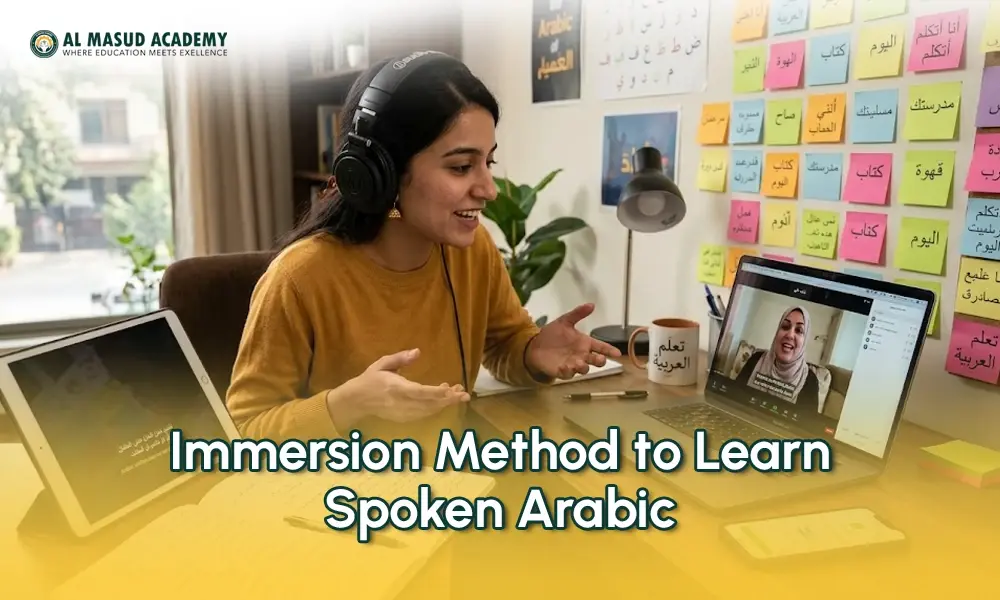
Why Immersion Is the Fastest Way to Learn Arabic
Most people try to learn Arabic through apps, grammar books, and vocabulary lists. It rarely works fast enough to matter. The immersion method to learn spoken Arabic is the fastest route to real conversation because it trains your brain the way it naturally learns language. You do not need to move to an Arab country. With the right setup, you can build a full Arabic immersion environment from home. Gulf Arabic is the ideal dialect for home immersion because it is spoken clearly, immediately useful in the GCC workplace, and well supported with resources. Combining daily immersion habits with structured live conversation practice is the fastest combination for adult learners.
You have probably tried at least one Arabic app. Maybe a phrasebook. Maybe a few YouTube videos. And you picked up a handful of words.
But after a few weeks, the progress felt slow. Conversations still felt out of reach. That is not your fault. That is the method. There is a faster way.
The immersion method for learning spoken Arabic works because it aligns with how the human brain is wired to learn any language.
Today, we explain what Arabic immersion really means, why it works faster than traditional study, and exactly how to do it from home without spending a dirham on a plane ticket.
The Problem with How Most People Try to Learn Arabic
Most popular Arabic learning methods teach you about Arabic instead of teaching you to use it. That gap between knowledge and real speech is why people stall after a few months.
Here is what the typical Arabic learning journey looks like. You download an app. You memorize greetings. You learn the alphabet. You do grammar drills.
After three months, you can recognize a few words, but you still cannot have a real conversation. You feel stuck. You might even think Arabic is just too hard for you.
The truth is simpler. The method is broken, not you.
And one honest thing worth saying is that apps don’t work for learning Arabic is not because apps are lazy. It is because apps drill isolated words and phrases without context, without real conversation, and without the kind of repeated meaningful exposure your brain needs to actually store language for long-term use.
Learning Arabic this way is like trying to learn swimming by watching videos and memorizing the strokes.
At some point, you have to get in the water.
What Arabic Immersion Actually Means (It is Not What You Think)
Immersion does not mean moving to Dubai or Cairo. It means surrounding yourself with real Arabic every day so your brain has no choice but to start processing it naturally.
The Traditional Definition of Immersion (Moving Abroad)
The classic idea of language immersion is moving to a country where your target language is spoken.
You have no other choice. The shopkeeper speaks Arabic. Your colleagues speak Arabic. The television speaks Arabic. You sink or swim. And most people swim, eventually.
It is powerful because the exposure is constant, total, and tied to real consequences. You need the language to live your day.
Modern Immersion: How It Works Without Leaving Home
The modern version of immersion follows the same principle but does not require a passport. Arabic immersion learning at home means making Arabic a daily presence in your life through deliberate choices about what you listen to, who you speak with, and how you engage with the language outside of formal study sessions.
The keyword is daily. Not weekly. Not whenever you feel motivated. Daily. Your brain builds language through repeated exposure over time, not through occasional cramming.
What True Immersion Does to Your Brain
When you hear the same Arabic phrases repeated in different real situations, your brain starts storing them as patterns rather than memorized items.
The phrase does not sit in your memory like a flashcard. It starts to feel automatic, like your own language does. That shift is the goal of immersion. It moves Arabic from conscious recall to natural response.
This is what separates immersion from traditional study. Memorizing vocabulary puts words in your short-term memory.
Hearing those words used in real conversations, over and over, in different emotional and situational contexts, makes them long-term automatic.
The Science Behind Why Immersion Works Faster
Language acquisition research consistently shows that the brain learns language best through meaningful exposure in context, not through grammar drills or isolated word memorization.
Input Hypothesis: How Your Brain Acquires Language Naturally
In the 1970s and 1980s, linguist Stephen Krashen developed a theory that became one of the most influential ideas in language teaching.
His Input Hypothesis argues that we acquire language by understanding messages in that language, especially when the content is just slightly above our current level.
It is sometimes written as ‘i plus 1’, where ‘i ‘ is what you already know and ‘plus 1’ is the next small step.
What this means practically is that you do not need to understand every word to benefit from listening. You need to understand most of it, with just enough new material to push you forward.
It is exactly what immersion creates naturally. You hear Gulf Arabic conversations. You catch most of it.
You pick up new phrases through context. Over time, your understanding grows without conscious grammar study.
Why Repetition in Context Beats Memorizing Vocabulary Lists
When you hear the word ‘yalla’ (let’s go) in a vocabulary list, your brain stores it as a fact. When you hear ‘yalla’ from your Qatari colleague as he grabs his keys and heads for the door, your brain stores it as an experience.
The second version sticks far better and surfaces faster when you need it. It is why conversational Arabic immersion builds vocabulary faster than flashcards ever will.
Research in neurolinguistics also tells us that emotional and social context strengthen memory encoding.
A word you hear in a real conversation, connected to a real moment, is simply more memorable than a word on a screen.
The Role of Real Conversation in Building Fluency
Listening builds your inner language bank. But speaking is what activates it. Real-life Arabic speaking practice forces your brain to retrieve words and structures under pressure, which is how they become automatic.
Research by Frontiers in Language Acquisition shows that regular output practice, meaning actual speaking, strengthens the neural pathways for language in ways that passive listening alone cannot.
This is why immersion programs that combine listening, reading, and speaking produce faster results than any single method used alone.
What Arabic Immersion Looks Like in Practice
Practical immersion is built from four daily habits: listening to native Arabic speech, speaking with real people, consuming Arabic content at your level, and gradually starting to think in Arabic.
Listening to the Native Gulf Arabic Daily
The easiest starting point is audio. You do not need to understand everything at first. Just get your ears used to the sounds, rhythms, and patterns of Gulf Arabic.
Put on Gulf Arabic podcasts while you cook. Listen to Khaleeji music during your commute. Watch short Gulf Arabic videos before bed. Make it a background habit first, then an active one.
- Gulf Arabic podcasts: Look for beginner or intermediate podcasts focused on daily conversations in the Gulf dialect.
- Khaleeji music: Artists like Hussain Al Jassmi sing in Gulf Arabic and are great for training your ear to natural speech patterns.
- YouTube channels: Search for Gulf Arabic tutors and native speakers. Even ten minutes a day makes a measurable difference over weeks.
Speaking With Native Speakers From Week One
Many beginners wait until they feel ready before speaking with native Arabic speakers. This is the biggest mistake you can make.
You will never feel ready enough if you keep waiting. Start speaking from week one, even if it is just ‘Marhaba, shloonak?’ (Hello, how are you?) Live Arabic conversation practice online is now available through language exchange platforms, online tutors, and structured course communities. Use them early and use them often.
Consuming Arabic Content That Matches Your Level
The key principle from Krashen’s research directly applies here. Content that is just slightly above your current level is the most useful for acquisition.
At the beginning, look for Arabic content made for learners. Gulf Arabic dialogues with transcripts are ideal. As you progress, move to content made for native speakers: short news clips, social media videos, and casual conversations.
One important thing for Bangladeshi learners starting from scratch. You do not need to learn Arabic script before you begin speaking Gulf Arabic.
You can learn to speak and understand Gulf Arabic using transliterated text while your reading skills develop in parallel.
Learning Gulf Arabic without the script explains exactly how this works and why it is a practical approach for total beginners.
Thinking in Arabic: When and How It Happens
One of the clearest signs that immersion is working is when you start thinking in Arabic. It does not happen overnight. It usually starts with small things.
You see a chair and think ‘kursi’ before you think ‘chair’. You want to say something, and the Gulf Arabic word comes before the English one.
The process develops naturally if you stay consistent with your immersion habits. You cannot force it. But you can create the conditions for it.
Immersion vs. Traditional Arabic Learning: A Direct Comparison
Traditional learning builds knowledge about Arabic. Immersion builds the ability to use it. Both have a role, but immersion produces speaking ability far faster for most adult learners.
Here is a side-by-side look at how the two approaches compare on the outcomes that matter most:
| Factor | Traditional Learning (Grammar Focus) | Immersion Method |
| Speed to first real conversation | Months to years | Weeks with consistent practice |
| Vocabulary retention | Low (isolated memorization) | High (context-based learning) |
| Pronunciation accuracy | Slow to develop | Improves quickly through listening |
| Grammar understanding | High (explicit rules) | Develops naturally over time |
| Confidence to speak | Often low (fear of mistakes) | Builds through repeated real use |
| Engagement and motivation | Can feel like a chore | Higher when the content is interesting |
| Long-term fluency | Possible but slow | Faster and more durable |
| Works without a teacher | Partially (books and apps) | Yes, with the right content setup |
Arabic immersion vs traditional learning is not a competition where one method always wins. Grammar knowledge has its place. But if your goal is to speak Arabic fluently, especially in a Gulf workplace setting, immersion produces results faster than any other approach.
Why Gulf Arabic Is the Ideal Dialect for Immersive Learning
Gulf Arabic is spoken more slowly and clearly than other major dialects, making it easier for beginners to process. It is also immediately applicable to the GCC job market, meaning every immersion session directly serves your real-life goals.
Not all Arabic dialects are equally suited to online immersive Arabic learning. Gulf Arabic has specific advantages for beginners:
- Clear pronunciation. Gulf Arabic speakers enunciate consonants and vowels more distinctly than Egyptian or Moroccan Arabic speakers. For a new listener, this makes it far easier to catch individual words and phrases.
- Steady pace. Gulf Arabic is generally spoken at a calmer pace than other dialects. This gives your brain more time to process what you are hearing, which speeds up natural acquisition.
- Immediate real-world value. If you are planning to work in the UAE, Qatar, Saudi Arabia, Kuwait, Oman, or Bahrain, every Gulf Arabic phrase you learn is directly useful. This practical feedback loop keeps motivation high.
- Growing content library. Gulf Arabic YouTube channels, podcasts, social media accounts, and online courses are expanding every year. There has never been more immersive Gulf Arabic content available to home learners.
For anyone asking how to get fluent in Gulf Arabic quickly, the answer is consistent immersion in Gulf-dialect content combined with regular live conversation practice. There is no shortcut. But there is a clear path.
How to Build an Arabic Immersion Environment at Home
You build a home immersion environment by making Arabic a daily presence across your regular activities. Replace some English media with Arabic. Set reminders to practice. Find a speaking partner. Structure your week so Arabic is always somewhere in your day.
Daily Listening Habits That Actually Move the Needle
The key is volume and variety. Your goal is to hear Arabic in as many different situations as possible. Here is a practical daily listening structure for beginners:
- Morning (10 minutes): Listen to a Gulf Arabic dialogue or short podcast episode while getting ready. No need to take notes. Just listen.
- Midday (10 to 15 minutes): Watch a Gulf Arabic YouTube lesson or native speaker video. Try to catch new words and phrases without looking up everything.
- Evening (20 minutes): Play Gulf Arabic content in the background while eating or relaxing. Khaleeji music, a Gulf Arabic TV clip, or a casual vlog.
Such habits add up to roughly 40-45 minutes of Arabic exposure daily, without requiring any dedicated study blocks. That is a foundation that quietly builds your listening skills week by week.
Finding Native Arabic Speakers to Practice With Online
Finding a native Gulf Arabic speaker to practice with is easier than most people think. Here is where to look:
- Language exchange apps: HelloTalk and Tandem let you connect with native Arabic speakers who want to learn your language in exchange.
- Online tutors: Platforms like italki and Preply have native Gulf Arabic tutors available for one-on-one sessions at affordable prices.
- Structured courses with community: The best option for most beginners is a course that includes live conversation practice built into the program, so you get structured learning and real speaking time together.
- Social media: Instagram, TikTok, and WhatsApp communities built around Gulf Arabic learning often have conversation practice groups.
Structuring Your Week for Maximum Immersion Effect
Consistency beats intensity. Six days of thirty minutes each will outperform one day of three hours every time.
Here is a simple weekly structure that works for adult learners with busy schedules:
| Day | Activity | Time |
| Monday | Structured Gulf Arabic lesson (live or recorded) | 30 to 45 minutes |
| Tuesday | Listening session with Gulf Arabic content | 30 minutes |
| Wednesday | Live speaking practice with a native speaker or tutor | 30 minutes |
| Thursday | Structured lesson or review of vocabulary in context | 30 to 45 minutes |
| Friday | Watch Gulf Arabic content (show, vlog, or YouTube) | 30 minutes |
| Saturday | Live conversation or group class practice | 30 to 45 minutes |
| Sunday | Light review, passive listening, Arabic music, or a podcast | 20 minutes |
The structure delivers roughly three to four hours of Arabic language immersion for adults per week without requiring you to take time off work or rearrange your life.
The Fastest Path: Combining Immersion With Structured Live Learning
Only immersion builds your ear and your vocabulary. Structured live lessons with a teacher give you correction, guidance, and speaking confidence faster than either approach alone.
The fastest way to learn spoken Arabic for most adult learners is not pure immersion and not pure classroom study. It is both together. Here is why.
When you only do immersion without guidance, you can develop listening skills and pick up phrases.
But you may also pick up incorrect pronunciation habits or never push yourself past the beginner level because you stay in comfortable, familiar content.
When you only take structured lessons without any immersion outside class, your progress between sessions is slow.
You spend the first fifteen minutes of each class mentally warming up before you actually start learning.
Combining both methods fixes these problems. Your immersion habits keep Arabic active in your brain between lessons.
Your lessons correct errors, push you into harder material, and give you real conversation practice with a native speaker who knows what they are doing. This is the core of a proper online Arabic immersion program.
For learners weighing their options, a practical next step is to decide whether live classes or self-paced lessons better suit your schedule.
The comparison between live Zoom classes and self-paced Gulf Arabic learning helps you make that decision based on your actual lifestyle, not just what sounds good on paper.
The bottom line on how to learn Arabic through immersion is this: build daily listening habits, start speaking early, use real Gulf Arabic content, and pair it all with at least two structured sessions per week. Follow that for ninety days, and you will be a different Arabic speaker than you are today.
Conclusion
The immersion method to learn spoken Arabic is not a secret or a shortcut. It is just the way the brain actually works. Your brain learns language through repeated, meaningful exposure in real contexts, not through memorizing grammar tables or tapping on phone screens.
The good news for Bangladeshi learners is that you do not need to be in Dubai or Doha to build this kind of immersion.
You need consistent daily habits, the right Gulf Arabic content, access to native speakers, and structured guidance to keep you on track.
Start today. Spend fifteen minutes listening to Gulf Arabic. Send one message in Arabic to a language partner. Watch one short video in the Gulf dialect.
Small daily steps, done consistently, compound into real fluency. The fastest path to speaking Arabic is the one you actually walk every day.
Frequently Asked Questions on the Immersion Method To Learn Spoken Arabic
Can you learn Arabic through immersion without living in an Arab country?
Yes, absolutely. Modern immersion does not require a plane ticket. You can build a full Arabic immersion environment at home using Gulf Arabic podcasts, YouTube channels, online tutors, language exchange apps, and structured online courses with live conversation practice. What matters is daily exposure and regular speaking practice, not your physical location. Thousands of learners around the world reach conversational Gulf Arabic without ever setting foot in the Gulf.
How many hours of immersion does it take to become fluent in Arabic?
Most language experts estimate that reaching conversational fluency in Arabic takes roughly 600 to 1,000 hours of meaningful exposure and practice for English speakers. With three to four hours of daily immersion, that is roughly six to nine months to basic fluency. With 1 to 2 hours daily, expect 12 to 18 months. The quality of your immersion matters as much as the quantity. Real conversations with native speakers are worth far more per hour than passive background listening alone.
What is the difference between immersion and just using a language app?
A language app gives you isolated vocabulary drills and scripted prompts in a controlled environment. Immersion exposes you to real Arabic used by real people in real situations. The brain retains language more effectively when it is learned in a meaningful context, with emotional and social anchors. Apps can be a useful supplement for vocabulary review, but they cannot replace the kind of varied, natural, and unpredictable exposure that actual immersion provides.
Is Arabic immersion effective for adults or only children?
Immersion works for adults, and in some ways, adults have an advantage. Adults have stronger working memory, better pattern recognition, and the ability to apply grammar rules consciously when needed. Children acquire language faster in total immersion because their brains are in a developmental phase optimized for language. But adults who immerse consistently, especially when they add structured learning alongside natural exposure, make strong and durable progress. Age is not a barrier.
What Gulf Arabic content can I use for home immersion?
You have strong options. For listening, Hussain Al Jassmi and other Khaleeji artists offer natural Gulf Arabic sounds in their music. Gulf Arabic YouTube channels and beginner podcasts provide structured listening practice. For speaking, italki and HelloTalk connect you with native Gulf Arabic speakers. For structured learning with built-in immersion, Al Masud Academy courses combine pre-recorded Gulf Arabic lessons with weekly live Zoom sessions, providing both passive and active immersion in a single program.
Should I learn grammar before trying Arabic immersion?
No. You do not need a grammar foundation to start immersion. In fact, starting with grammar often creates anxiety and delays real use of the language. Immersion builds your instinct for what sounds right in Arabic, and grammar knowledge develops naturally alongside it. A minimal grammar overview after your first month helps you understand patterns you are already hearing. But do not wait for grammar mastery before starting immersion. Start listening and speaking from day one.
How do I find native Gulf Arabic speakers to practice with online?
The most reliable options are italki for paid one-on-one sessions with qualified Gulf Arabic tutors, HelloTalk and Tandem for free language exchange partnerships, and structured courses that include live group conversation sessions. Reddit communities like r/learnArabic and Arabic-learning Facebook groups also have active members who are happy to engage in conversation exchanges. The quickest option for most beginners is a structured course with a built-in practice community, because you get speaking time with a native teacher and fellow learners at the same time.
Categories
Recent Posts






You May Also Like

Arabic is not one language. It has many spoken dialects, and picking the wrong one wastes months of your time....
-
-
April 12, 2026

Both Gulf Arabic and Egyptian Arabic are powerful dialects, but they serve very different purposes. Gulf Arabic (also called Khaleeji...
-
-
April 8, 2026

You don’t need a language degree, a sabbatical, or two free hours a day. If you live and work in...
-
-
April 3, 2026