
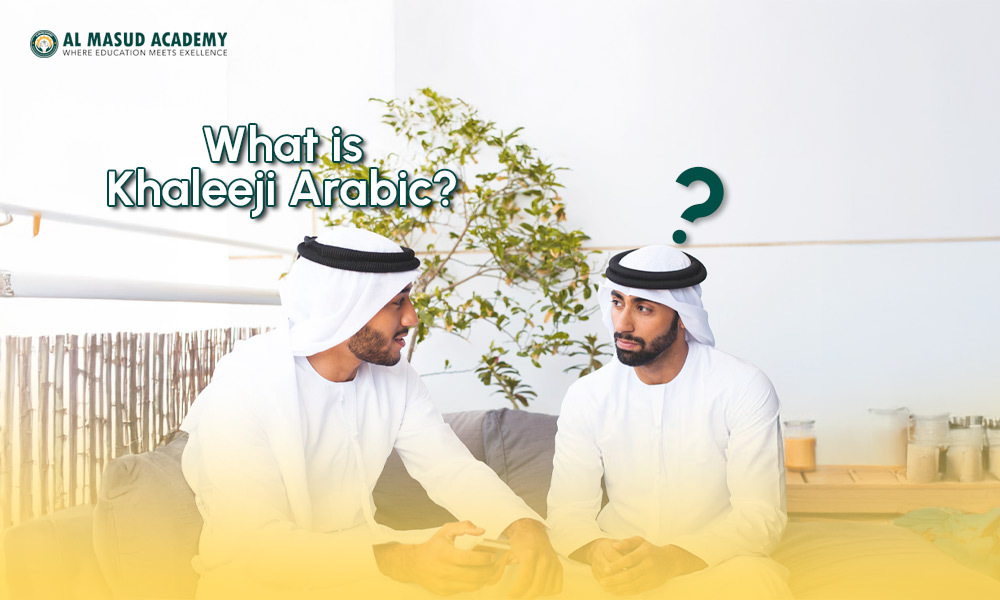
What is Khaleeji Arabic? A Complete Guide to Gulf Arabic Dialects
Masud Atik
February 23, 2026
No Comments
Khaleeji is the tongue of the thriving Arabian world. A good grasp of it will instantly place you at the heart of the social and economic structures of the Gulf region, including the richest Arab lands: the Emirates, Qatar, Saudi Arabia, and Kuwait. But learning Khaleeji is not a dreamwalk that ends with an effortless mastery. Spoken by millions on the varied cultural backdrops, the Khaleeji dialect demands you to be strategic to master local phonetics, phrase-based delivery, and native expectations.
To feel confident about the Khaleeji dialect, you must have your purpose well-defined, understand how it differs from other variants, know what makes it one of the most lucrative languages to learn right now, and follow an effective roadmap to achieve fluency. Once you get there, it will make the rest of the journey, like taking a resourceful course, choosing a seasoned mentor, and advancing toward native-level proficiency, much easier.
Let’s uncover unknown aspects of the Khaleeji dialects in the context of its comparative model, appeal to non-native learners, step-wise learning roadmap, and common myths that stir confusion.
What Does “Khaleeji” Mean in Arabic?
Khaleeji in Arabic means “of the Gulf.” It’s the vocal expression of the people who live around the Arabian Gulf, internationally known as the Persian Gulf. Like daily apparel and lifestyle, how natives of these regions utter words varies from the rest of the Arabian nations. While the formation of words follows the same principle with the same letters, dialects differ in how they are pronounced and spoken.
Arabic has no shortage of local dialects. Even the Gulf or Khaleeji is not a single vernacular. Rather, it’s a combination of at least ten distinguishable micro-dialects with shared commonalities. And learning Khaleeji will allow you to understand and communicate with the locals, despite their slightly disrupted practices.
Is Khaleeji Arabic the Same as Gulf Arabic?
In respect of spoken practices, the terms Khaleeji and Gulf are the same local way of talking. As they represent the same locality in two different languages. What is “Gulf” in English is “Khaleeji” in Arabic. But when it comes to the cultural domain, Khaleeji has a broader impact than Gulf.
Khaleeji is, in fact, the name of the integral lifestyle and unique cultural rituals the Gulf Arabians observe on a daily basis. It refers to their unique taste in fashion, music, and art. The expression and celebration of their emotions and life events. So when you say Khaleeji, you point at:
- The Gulf dialects, with comparatively softened and muffled phonetics
- The long, thick robe, Thobe, for men, and the black embroidered cloak, Abaya, for women
- The phenomenal scents of Oud and Bukhoor that locals are enchanted with, and the whole world knows for Arabian perfume
- The melody of Ouds played with the rolls of small drums called Mirwas, the energetic songs sung at a rushing beat, pulsating local emotions
- The dominant patriarchy, strong family bonds, and the reciprocating generosity
The word Gulf only draws the boundary of a specific region, whereas Khaleezi is how people live in it. As the primary local lingo and a crucial part of the culture, the particular dialect of the Gulf inhabitants is both mentioned as the Gulf dialect and the Khaleeji dialect.
How to Approach Khaleeji Arabic for Learning?
From greeting and dealing to treating people, every community follows a code. Without incorporating it into your own behavior, you won’t sound natural merely with memorized words and a conjured accent. You will sound desperate and immature, instead of cordial and true. That’s why it’s necessary to devise an approach that leads to effortless and context-based interaction. That’s why you need to:
Reflect on The Cultural Intent
The Gulfs are fond of politeness. Their urgency to overwhelm the person in front with the utmost solemnity and warmth has largely shaped the intonation of the Khaleeji dialect. The emphasis and rhythms are placed on the places to make it sound graceful and holy. So when learning it, you need to focus on those traits and absorb the intent. Like, don’t just greet with a Salam; stretch the part that says peace.
The Gulf Ways of Social Bonding
You shouldn’t regret realizing that you fall short in meeting, conversing, and inviting people, failing to maintain the very level of hospitality and generosity that locals offer. It’s a trait that goes rarely unnoticed, triggering self-humiliation and unexpected social responses. So, even before starting with the dialect, study the rapport factors and how the dialect is used to make a relationship.
The Religious Incantations
Being firmly faithful to Islam and guided by it, the Gulf residents start and end their work with various short or long recitations. Beyond, they are meant to respond to others’ recitations if heard. As a non-native, who is out of practice, you may find it difficult to blend in if you don’t familiarize yourself with the common recitations first.
How to Plan Your Khaleeji Learning Roadmap?
Brace before jumping into the depths, as it will reward you with the scope and time to mull over an effective strategy. Because you will need one to form a sequential learning model where the phases are unrolled by priority.
Here is a funnel we have found relevant and acclaimed by students who started as novices and are currently living in the zone.
Making up the Ears
Ears outrule even the tongue in the question: Which is to be trained first? Imagine having a sharp accent with the least ability to make sense of others’ words. What would that help? You can’t tell it a successful conversation for sure.
Preparing your ears ahead of time will enable you to grab words and expressions more easily. So you can memorize them by their connotation and semantic interpretations, instead of blind repetition. At the end of this stage, check whether you can detect the Gulf melody and distinguish it from other dialects.
Colloquial Etiquette
Vocabulary is a fundamental element of the social mannerism codebook. What expression you use in a certain setting exposes your belongingness to the ambience or a cult. In respect to the Gulf context, down-to-earth simplicity, unconditional generosity, and religious affinity set the expectations. To breach into it, candid performance and gesture go the farthest.
When climbing the word ladder, don’t just touch the surface meaning. Best is to begin with social events in mind. Think of all the situations you may have to interact with others in, and cover them one by one. Conversion starters, small talks, conventional replies, and bidding goodbye are common phases of every scenario.
Which Countries Speak Khaleeji Arabic?
A close look at the regions the Gulf dialect is prevalent in reveals its historical value. It’s the very soul of the Islamic realm and the source of its diversity stream. And its strong flow has swept into surrounding muslim nations, too. For say:
- Southern Iraq: Basra, the small city of southern Iraq, famous as the home of piety and awlias, like Rabaya Basri (RA) and Hasan Basri (RA) uses Gulf collocations. So are some other peninsular cities in the country.
- Southern Iran: Iran also has a few areas attached to the Persian coast. So they share similar coastal culture, including the Gulf vernacular. Among these, remarkable are Bushehr and Hormozgan, two coastal provinces. Two nearby islands, Qeshm and Kish, have also adapted to their neighboring mainland’s voice.
- Migrated Minorities: Once the widest and the face of the Arabic world, Persia has attracted muslims to migrate into the reign of caliphs. While many have left afterward, there are still stranded communities articulating themselves through the Gulf dialects. Zanzibar and coastal Kenya make ideal examples.
- Western Groups: Students aiming for higher studies have accumulated in multiple large groups in London, New York, and Los Angeles. Mostly from the Gulf regions, these small ethnicities talk and live in Khaleeji.
Are All Khaleeji Arabic Accents the Same?
Though formed around a single core structure, not all Gulf dialects sound alike. The secret lies in their pace and ancestral business travel routes. Ancient Arabian merchants dispersed, some moving into the western countries, some seeking opportunities in the east. Some crossed the Persian Gulf to eastern southern Asian nations. This has brought mutual diversity to both the hosting and migratory cultures.
Saudi Arabia: Once the place of true desert riders, outwardly dependent on other Arab cities for business and the very root of Bedouin roamers, Saudi Arabia has set the foundation of the Gulf eloquence. Najdi and Hejazi are the primary Khaleeji variants you will find here.
Kuwait: Kuwait preferred north-west roots for dealing. The merger of Persian, Turkish, and English in Kuwaity dialect is self-evident. Over time, it has become punchier and musical.
United Arab Emirates (UAE): Softer and breezier, with a lack of breaks and punches, Emirati dialects sound the smoothest of all Khaleeji dialects.
Can Arabs Understand Khaleeji Arabic Easily?
And the answer often shakes them off their initial commitment, sparking confusion. Yes, the Gulf has its variations. But here is why this mere fact shouldn’t be taken as an obstacle.
- Mutual Understanding: Roaming in the Gulf countries is a unique experience, with people stressing the same word a bit differently, having a unique rhythm based on their locality, and varying in the pace of their vocal cords. But that’s that. The meaning of the words, 90% of which are common in every Gulf variant, doesn’t change. So learning one will allow you to communicate in all.
- Flexible Shifting: After becoming comfortable in one dialect, adopting another takes no more than a few weeks. A few vowel changes here and there, subtle nuances for one or two letters. Tackle them, and you have just learned another. With effort, you can take it to the next level, but slow growth won’t come in the way of your objective.
- Relevance Outside the Gulf: The Khaleeji is also relevant on the other side of the Red Sea. As mentioned, estranged Gulf speakers are surviving there despite the differences. And that calls for a reason to believe in the shareability between the local and Gulf dialects.
- Addressing Initial Bottleneck: The Gulf unfolds in softened expressions of Qaf and Jim, sounding Gaf with a G and Yim with an Y. Having its root in the traveling and merchandising ethnicities, like Beduine and sea-going fishers and businessmen, this local dialect has got some Persian, South Asian, English, and Turkish fragments mixed up. The Glutteral intonation is another feature that has come from the Beduine ways. Picking up on all these feel troublesome at first. Even with some MSA knowledge. The voice training phase addresses this problem, helping learners overcome it even before getting into the vocabulary.
Khaleeji Arabic vs Modern Standard Arabic (MSA)
Simply put, Arabians barely use MSA for speaking in the local context and seldom use dialects for writing. Like every written form of any language in the world MSA differs from the regularly spoken variations. Here is how:
Grammar and Syntax: MSA represents the standard Arabic grammar. Intricate rules, principles of weaving words for semantics and style. These are the gateway into the syntactically tight MSA form. Dialects, in converse, usually have little care for such boundaries. So learning them is a comparatively quicker process.
Where they Apply: Gulf residents need MSA for all types of reading and writing situations. Legal dealings, publications, study, and formal business communication are done through MSA. But dialects rule every situation where you have to find your lingua emotica and talk with a person. Even if it’s in a court and in any other institutions.
Should You Learn Khaleeji Arabic or MSA First?
The fatigue can feel intimidating for a first-time learner. Much, like the learning curve, progress system, and application scope, relies on the choice between the Fusha (MSA) and Khaleeji. Which one is more supportive in learning another is the question that confuses the most.
Cut around a regrettable end result by:
- Choosing Khaleeji: When permanent residence, rapport-building, and native efficiency drive your intent. From respectful greeting, cordial farewell, to joke-cracking moments, Khaleeji blends you into the Gulf lifecycle like a fine grain. Satisfactory living is impossible without its in-depth mastery.
- Choosing MSA: Prior knowledge reduces the initial struggle, but not a prerequisite for learning a dialect. If formal context and academic approach scare you, leave MSA roadmap for a later study.
Is Khaleeji Arabic Useful for Jobs in the GCC?
One non-native misconception rules out the usage of a dialect in the commercial sector. It’s true that what you pass in files is MSA. But what about the rest of the value transactions with coworkers and clients?
- Fluid Responses: Replying a dialect with a formal cadence is plain boring. Sympathy, condolence, and compassion need heart-sourced expression to bring the expected impact and connection. The demanded empathy is hard to find in a flattened syntax.
- Trustworthy Presence: Allowing multinational communication, MSA has raised popularity among travelers and short-term passersby. While they still receive hospitality but it doesn’t surpass the conventional boundary. Pour out a few local expressions in the meeting and it will thousandfold your reliability.
- Authoritative Posts: People skill dominates managerial ranks. Something that only builds up on empathic intent and solid bonds. Dialects help resonate with local staff, paving the path to a harmonized workspace and responsive organizational model.
How Al Masud Academy Teaches Spoken Arabic for the Gulf
Al Masud Academy offers the only Gulf dialect course designed for long-term efficacy. Planned and presented by native mentors, aimed at a non-native audience, to turn them into fluent Khaleeji talkatives at the expense of a few months. We take pride in a zero dropout rate, practical strategies, like ear and phonetics training, shadow practices, and strict assessment criteria. Only students are conferred with a certificate of mastery.
Subscribing to us invites you to:
- A balanced and guided series of live video sessions to ensure an adaptable study routine
- An independent pre-recorded module allowing self-paced learning
- Growth-led curriculum focused on gradual and guaranteed upskilling
- Seasoned teachers with experience living in the GCC regions
- Suggestions for etiquette and behavioral development in a teaching situation-based vocabulary
- Regular assessments to probe weaknesses and provide special support
- Prices are kept at a minimum and affordable for people of all interests
Wrapping Up
Stepping into the Khaleeji world is like discovering a whole new universe. The distinction is remarkable between the rest of the globe and the Khaleeji people, geological, political, cultural, and economic landscapes, and also the spiritual and historical values. And the Khaleeji dialect is not only the threshold, but the only gateway to this rich diversity. And your success as an expat in the local community depends on how spontaneous you can appear in the eyes and ears of the natives. To elevate to that zone, you will need guidance and a objectively designed course, like the ones Al Masud Academy is offering.
FAQ
Is Khaleeji Arabic written or only spoken?
Khaleeji is only passed via mouth. While MSA is the Arabic form used in scriptures across all Arabic countries. Among the many dialect variations, Khaleeji dominate the nations located along the Persian and Read Sea bays.
Which Khaleeji Accent is Easiest to Learn?
All vocal colloquies are easier to learn compared to MSA. However, the question of choice should emphasize more on the usability of a dialect in a particular region, instead of their learning curve. Like, for UAE or Saudi Arabia aspirants, learning Khaleeji comes as the sole choice.
Do Gulf TV shows use Khaleeji Arabic?
Every nation has their own media broadcasting in their local dialects. So is true for Khaleeji speaking countries. Specially, Kuwaiti Khaleeji has grown popular in the surrounding lands serving programs where actors and presenters represent their own tongue.
Can I survive in the Gulf with only English?
Having a short trip is one thing. English will allow you in throwing out a few sentences and shakes a few hands. But navigating the complex situations, like bargaining in malls and streets over highly hawked prices and seating in a community lounge and sharing opinions over daily lives and nuances, dialects will make you up for it.
Categories
Recent Posts


You May Also Like
Most people try to learn Arabic through apps, grammar books, and vocabulary lists. It rarely works fast enough to matter....
-
-
April 13, 2026
Arabic is not one language. It has many spoken dialects, and picking the wrong one wastes months of your time....
-
-
April 12, 2026
Both Gulf Arabic and Egyptian Arabic are powerful dialects, but they serve very different purposes. Gulf Arabic (also called Khaleeji...
-
-
April 8, 2026
Get in touch
Call us directly?
+97466006082
Address
Doha, Qatar
almasudacademy.ae@gmail.com
Quick links
Company info
- Al Masud Academy Ltd
- Company No: 16543624
- Registered in: England & Wales
- Office 12, Initial Business Centre
- Manchester, UK M40 8WN
- © 2026 Al Masud Academy Ltd | Registered in England & Wales | Company No. 16543624